


How to Choose the Right Solar Inverter for Your South African Business: Types, Features and Practical Tips
Load shedding. Rising electricity costs. Unreliable grid supply.
If you’re a South African business owner, these challenges are all too familiar. And if you’re considering solar power as a solution (which you absolutely should be), choosing the right solar inverter is one of the most critical decisions you’ll make.
A solar inverter isn’t just a technical component, it’s the heart of your solar power system. It converts the DC electricity from your solar panels into the AC electricity your business uses every day. Get this choice wrong, and you could end up with an inefficient system that doesn’t deliver the savings or reliability you need.
Get it right, and you’ll maximise your return on investment, reduce your dependence on Eskom, and potentially save your business thousands of rands each month.
This guide breaks down everything South African commercial property owners and facility managers need to know about choosing the best solar inverter for your business.
What Is a Solar Inverter and Why Does Your Business Need One?
A solar inverter converts the direct current (DC) electricity generated by your solar panels into alternating current (AC) electricity that powers your offices, warehouses, factories, and equipment.
Without an inverter, the electricity from your solar panels would be unusable for most commercial applications.
But modern solar inverters do far more than just convert electricity. According to the UK Government’s solar guidance, quality inverters also:
Maximise energy production – Advanced inverters optimise power output even in less-than-ideal conditions
Ensure system safety – They protect your installation from electrical faults and surges (critical during South Africa’s frequent grid fluctuations)
Provide performance monitoring – Real-time data on your solar generation helps you track savings and identify issues early
Enable battery integration – Many modern inverters support battery storage, allowing you to store excess solar power for use during load shedding or peak tariff periods
For South African businesses facing Eskom’s unreliable supply and escalating tariffs, these benefits translate directly to:
- Reduced operating costs through lower electricity bills
- Business continuity during power outages
- Energy independence from an unreliable grid
- Environmental credentials that matter to customers and stakeholders
The National Renewable Energy Laboratory highlights that inverter efficiency is a key factor in long-term system performance, something every business owner should consider when calculating return on investment.

Understanding the Three Main Solar Inverter Types
Solar inverters aren’t one-size-fits-all. The right choice depends on your property layout, energy needs, budget, and long-term business goals.
The three primary inverter types available in South Africa are:
- String Inverters – The traditional, cost-effective choice for large, unshaded commercial rooftops
- Microinverters – Panel-level optimisation ideal for complex roofs or properties with shading issues
- Hybrid Inverters – Advanced systems that integrate solar, battery storage, and grid power for maximum flexibility
Each type offers distinct advantages and trade-offs. According to the Solar Energy Industries Association, understanding these differences is essential for making informed commercial solar decisions.
Let’s break down each option.
String Inverters: The Cost-Effective Commercial Standard
String inverters have been the commercial solar industry standard for decades, and for good reason.
How String Inverters Work
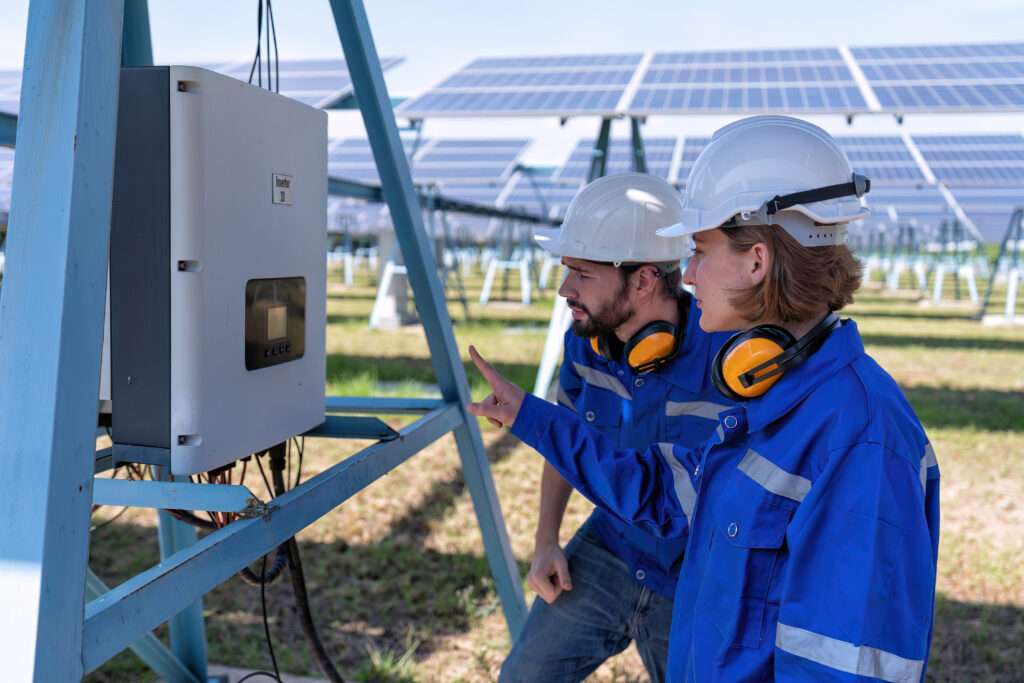
String inverters connect multiple solar panels in series, forming a “string”. All the panels in that string feed into a single centralised inverter unit, typically mounted on a wall near your distribution board.
This design is simple, proven, and cost-effective, making it the go-to choice for many South African commercial installations.
Best Use Cases
String inverters work brilliantly for:
- Large, unobstructed commercial rooftops with consistent sun exposure
- Industrial facilities with extensive roof space
- Budget-conscious projects where upfront cost is a priority
- Simple roof layouts without significant shading from neighbouring buildings or structures
According to the Energy Saving Trust, string inverters offer excellent efficiency when conditions are right.
The Shading Problem
Here’s the catch: string inverters have a significant weakness when it comes to shading.
Because panels are connected in series, even partial shading on one panel reduces the output of the entire string. In urban South African settings where neighbouring buildings, trees, or rooftop equipment might cast shadows, this can seriously impact your system’s performance.
Pros:
- Cost-effective – Lowest upfront cost per watt
- Simple installation – Fewer components mean faster deployment
- Easy maintenance – Centralised unit is accessible for servicing
- Proven reliability – Decades of commercial track record
- Ideal for large installations – Scales efficiently for big commercial roofs
Cons:
- Shading sensitivity – Performance drops significantly if any panel is shaded
- String-level monitoring only – Can’t identify individual panel issues
- Less flexible – Not ideal for complex roof layouts
- Single point of failure – If the inverter fails, your entire system stops producing
Bottom Line for SA Businesses:
String inverters make excellent financial sense for warehouses, factories, and commercial buildings with large, unshaded roof space. If your property has minimal shading and you want to maximise your rand-for-rand return, this is your best bet.
Microinverters: Panel-Level Performance for Complex Sites
Microinverter technology represents a more modern approach to commercial solar power.
How Microinverters Work
Unlike string inverters, microinverters operate individually for each solar panel. Every panel gets its own small inverter unit mounted directly on the back of the panel on your roof.
This decentralised approach offers significant advantages for certain commercial applications, particularly in dense urban environments. The National Renewable Energy Laboratory commonly recommends microinverters for complex commercial rooftops.
Best Use Cases
Microinverters excel in scenarios where:
- Shading is unavoidable – Buildings surrounded by taller structures or trees
- Roof layouts are complex – Multiple roof levels, orientations, or angles
- Panel-level monitoring is valuable – When you need detailed performance data
- Gradual expansion is planned – Easy to add more panels over time
- Maximum production is critical – Even in less-than-ideal conditions
The Shading Advantage
The key benefit of microinverters is their independence. Shading on one panel doesn’t affect the others. This can make a dramatic difference in total system output for properties in urban areas like Johannesburg, Cape Town, or Durban where shading is common.
Pros:
- Panel-level optimisation – Each panel performs independently
- Superior shading performance – One shaded panel doesn’t affect the rest
- Detailed monitoring – Track performance of every individual panel
- Flexible installation – Accommodates complex roof layouts
- Scalable – Easy to expand your system panel by panel
- No single point of failure – If one microinverter fails, only that panel is affected
Cons:
- Higher upfront cost – Typically 20-30% more expensive than string inverters
- More components – More potential points of failure over time
- Roof-mounted electronics – Exposed to weather and harder to service
- More complex installation – Requires more time and labour
Bottom Line for SA Businesses:
If your commercial property has shading challenges, multiple roof levels, or a complicated layout, microinverters can deliver significantly better long-term performance despite the higher initial investment. They’re also ideal if you want detailed production monitoring.
Hybrid Inverters: Future-Proofing Your Business Energy
Hybrid inverters represent the cutting edge of commercial solar technology in South Africa.
How Hybrid Inverters Work
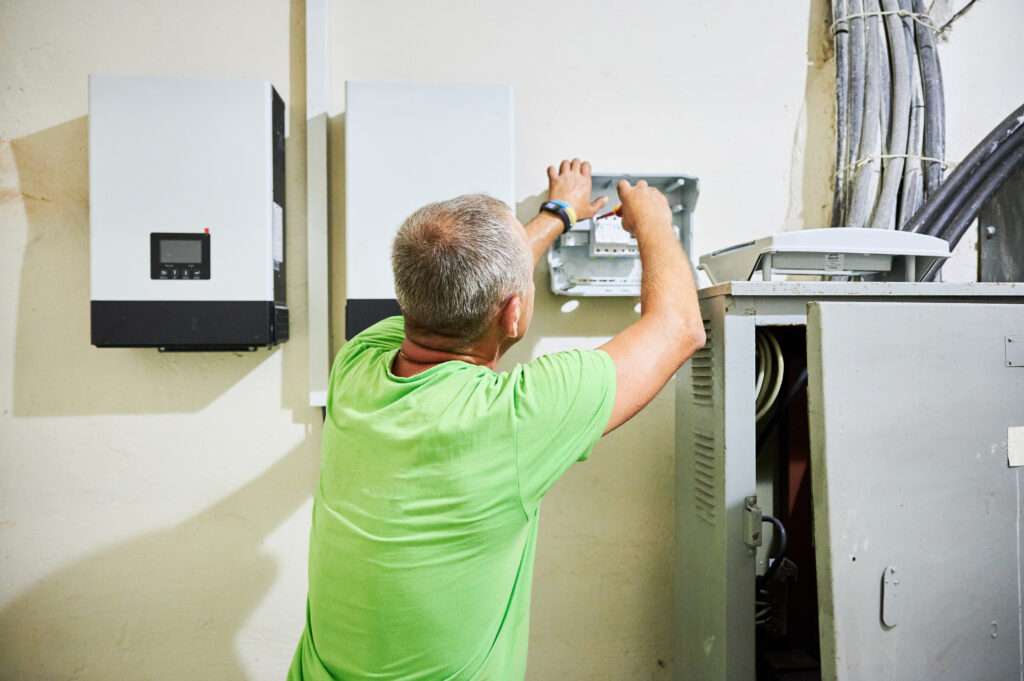
Hybrid inverters combine traditional solar conversion with intelligent energy management. They integrate three power sources: solar panels, battery storage, and the Eskom grid.
The system automatically manages energy flows based on your settings, prioritising solar power, storing excess in batteries, and seamlessly switching between sources as needed.
This flexibility is particularly valuable in South Africa’s challenging energy environment. The International Renewable Energy Agency highlights hybrid systems as essential for businesses seeking energy independence.
Best Use Cases
Hybrid inverters are ideal for:
- Businesses requiring uninterrupted power – Medical facilities, data centres, manufacturing
- Companies facing high demand charges – Use stored power during peak tariff periods
- Properties experiencing frequent load shedding – Automatic backup power
- Businesses planning battery storage – Even if not installed immediately
- Forward-thinking companies – Future-proofing for evolving energy needs
The Battery Storage Advantage
With load shedding showing no signs of disappearing, battery storage has become increasingly attractive for South African businesses.
Hybrid inverters allow you to:
- Store excess solar power generated during the day
- Use stored power during load shedding instead of diesel generators
- Avoid peak electricity tariffs by using battery power during expensive periods
- Sell excess power back to the grid (where municipal regulations allow)
- Maximise solar self-consumption rather than feeding back to Eskom
Pros:
- Multi-source energy management – Seamlessly switches between solar, battery, and grid
- Load shedding protection – Automatic backup power when Eskom fails
- Peak shaving capability – Reduce demand charges significantly
- Energy independence – Reduce reliance on an unreliable grid
- Future-ready – Easy to add battery storage later if not installed initially
- Maximised solar use – Store what you generate, use it when you need it
Cons:
- Higher upfront cost – Most expensive inverter option
- Requires battery investment – To realise full benefits (though batteries can be added later)
- More complex installation – Needs experienced installers
- Sophisticated system management – May require professional monitoring
Bottom Line for SA Businesses:
If your business needs reliable power regardless of Eskom’s performance, or if you face high demand charges, hybrid inverters offer the best long-term value. The initial investment is higher, but the operational savings and business continuity benefits often justify the cost within 3-5 years.
Which Inverter Type Is Right for Your South African Business?
Choosing between these options depends on several factors specific to your situation:
Consider String Inverters If:
- You have a large, unshaded commercial roof
- Upfront cost is your primary concern
- Your roof layout is simple and uniform
- You want proven, reliable technology
- You need the fastest return on investment
Consider Microinverters If:
- Your property has unavoidable shading
- Your roof layout is complex with multiple levels or orientations
- You value detailed performance monitoring
- You may want to expand your system gradually
- You need maximum production in challenging conditions
Consider Hybrid Inverters If:
- Load shedding significantly impacts your business
- You face high demand charges or peak tariffs
- Business continuity is critical (medical, manufacturing, data)
- You want to add battery storage now or in future
- Energy independence is a strategic business goal
The World Economic Forum’s smart city energy planning emphasises that the “best” solution balances immediate costs against long-term strategic benefits.
Key Features Every Commercial Solar Inverter Should Have
Beyond the basic inverter type, South African businesses should evaluate these critical features:
1. Inverter Efficiency
Efficiency determines how much of your solar power actually becomes usable electricity. Look for inverters with efficiency ratings above 95%, many premium models achieve 97-98%.
The International Energy Agency notes that even a 2-3% efficiency difference can significantly impact long-term returns on commercial systems.
Efficiency impacts:
- Total energy production
- Operating costs over system lifetime
- Return on investment timeline
2. Grid Compatibility and Safety Features
South Africa’s grid is notoriously unstable. Your inverter must handle:
- Voltage fluctuations common on Eskom’s network
- Automatic disconnection during grid failures (required by law)
- Anti-islanding protection for safety
- Surge protection during lightning storms (critical in highveld regions)
3. Monitoring and Data Capabilities
Modern commercial inverters should provide:
- Real-time production monitoring via web or mobile app
- Historical data analysis to track savings
- Alert systems for performance issues
- Individual panel monitoring (for microinverters)
- Integration with building management systems
Quality monitoring helps you identify problems early and maximise your solar investment’s value.
4. Warranty and Support in South Africa
Check that your chosen inverter has:
- Local distributor and support – International brands with SA presence
- Comprehensive warranty – Minimum 5 years, ideally 10+ years
- Available spare parts – Can replacements be sourced locally?
- Qualified installers – Experienced with your chosen brand
- Track record in SA conditions – Proven performance in our climate
According to the Energy Saving Trust, warranty and local support are crucial for long-term commercial system reliability.
5. Scalability and Expansion Options
Your business may grow. Can your solar system grow with it?
- Modular design for easy expansion
- Multiple string inputs (for string inverters)
- Additional panel capacity without replacing the inverter
- Battery compatibility for future storage addition
Practical Tips for South African Business Owners
1. Get a Professional Site Assessment
Don’t guess at your solar needs. A qualified solar installer should:
- Analyse your roof structure and shading
- Review 12 months of electricity bills
- Calculate your actual energy consumption patterns
- Recommend appropriate system size and inverter type
- Provide detailed financial projections
2. Factor in Load Shedding
South Africa’s unique challenge deserves special attention. Consider:
- How often is your area load shed?
- What’s the financial impact of each power outage?
- Would battery storage pay for itself through avoided losses?
- Can you time high-energy processes for solar production hours?
3. Understand Your Tariff Structure
Eskom’s tariff structure significantly impacts inverter choice:
- Time-of-use tariffs favour battery storage
- Demand charges make peak shaving valuable
- Standard tariffs may make simple string inverters most economical
4. Plan for Maintenance
Commercial solar systems need ongoing care:
- Annual cleaning in dusty areas (particularly in Gauteng and Free State)
- Regular inverter checks and software updates
- Panel inspections after severe weather
- Monitoring system review
Build these costs into your financial planning from the start.
5. Don’t Compromise on Quality
The cheapest inverter is rarely the best value. Consider:
- Total cost of ownership over 20-25 years
- Warranty coverage and support
- Efficiency losses costing you money daily
- Replacement costs if cheap equipment fails early
Quality brands with local support typically deliver better long-term returns.
Future Trends in Commercial Solar Inverters for South Africa
The solar inverter market is evolving rapidly, driven by South Africa’s unique energy challenges:
Smart Grid Integration
Future inverters will better integrate with municipal and private smart grids, allowing:
- Peer-to-peer energy trading between businesses
- Grid stabilisation services (potentially earning revenue)
- Demand response participation
Enhanced AI and Machine Learning
Next-generation inverters will use AI to:
- Predict energy production based on weather patterns
- Optimise battery charging/discharging schedules
- Identify maintenance needs before failures occur
- Automatically adjust to changing energy tariffs
Higher Power Density
Commercial inverters are becoming more compact whilst handling higher power loads, ideal for space-constrained urban properties.
Improved Battery Integration
As battery costs continue falling, hybrid inverters will become standard for commercial installations, with seamless storage integration recommended by the International Renewable Energy Agency.
Making the Right Choice for Your Business
Choosing the right solar inverter is a critical business decision that will impact your bottom line for decades.
String inverters offer the best value for straightforward commercial installations with minimal shading.
Microinverters deliver superior performance for complex sites where shading or roof layout challenges would compromise string inverter efficiency.
Hybrid inverters provide maximum flexibility and resilience for businesses that need reliable power regardless of Eskom’s performance.
The right choice depends on your specific circumstances: your property, your energy needs, your budget, and your long-term business strategy.
Don’t make this decision alone. Work with experienced solar professionals who understand South African commercial installations and can provide honest, unbiased advice based on your actual needs, not just what they have in stock.
Ready to Take Control of Your Business Energy Costs?
At Solar Projects, we specialise in commercial solar installations across South Africa. Our team has designed and installed systems for warehouses, factories, office parks, retail centres, and everything in between.
We’ll assess your property, analyse your energy consumption, and recommend the inverter solution that delivers the best long-term value for your specific situation.
Want to find out which inverter will be best for your business?
Get in Touch with Solar Projects for a free commercial solar assessment.

Frequently Asked Questions about Solar Energy
- Cost reduction
- Energy independence
- Eco-friendly
- Incentive opportunities
- Property value
The answer, though, is simple: Large appliances. If you're running a central air conditioner (which uses about 2,000 kilowatt hours of electricity per year), heat pump, or clothes washer or dryer frequently, you could be consuming much more energy than you regularly do.
Yes, solar panels work on cloudy days, but they are significantly less efficient and produce about 10–25% of their normal power output. Sunlight still reaches the panels as a diffuse light source, and modern panels can still generate electricity, though much less than on a clear, sunny day. The exact amount of power generated depends on the cloud cover's thickness.
The size of the solar system you need depends on your energy consumption, the size of your roof, and the amount of sunlight your home receives. Get in touch today and let us help you determine the appropriate size for your needs.
While it is possible to install a solar system yourself, it is highly recommended to hire a professional solar installer (like us) to ensure that the system is installed safely and correctly.
WHO WE ARE AT SOLAR PROJECTS
Solar Projects part of the EEC family, offering a full range of solar energy services, from designing and installing your system to keeping it running smoothly with ongoing maintenance.
We help our clients with:
- Solar Financial Solutions
- Residential Solar Projects
- Commercial Solar Projects
- Solar Rent To Own Financing
